Why VOOG Deserves a Permanent Spot in a Young Investor's Portfolio 📌
The Vanguard S&P 500 Growth ETF (VOOG) isn't just another index fund. It cherry-picks 148 of the fastest-growing names from the S&P 500 and discards the other 352 — which means you're buying momentum, sales growth, and AI leadership in a single ticker.
For investors in their 20s, the math is brutal in the best way possible. Since its 2010 launch, VOOG has compounded at 16.9% annually, versus 14.2% for the plain S&P 500. That 2.7-point gap sounds small — until you run it over four decades.
The Numbers That Matter
- AUM: $26B
- Expense Ratio: 0.07%
- Dividend Yield: 2.18%
- Top Holdings: NVDA (14.85%), MSFT (10.47%), AAPL (6.46%)
Over 51% of the fund sits in information technology — not by accident, but because that's where sales growth and price momentum currently live.

The AI Engine Powering This ETF 🚨
The top five holdings — Nvidia, Alphabet, Microsoft, Apple, and Broadcom — represent roughly 35.6% of the portfolio. That's concentration risk, yes. But it's also why the fund has crushed the broader index.
- Nvidia supplies the data-center chips behind nearly every major AI training workload, with revenue forecast to grow ~90% this fiscal year.
- Broadcom has emerged as a serious Nvidia competitor with customizable AI accelerators, tracking ~65% revenue growth.
- Microsoft monetizes AI through Azure, renting compute to the world's biggest model developers.
- Apple is pushing Apple Intelligence across 2.5 billion active devices.
- Alphabet leverages Gemini across Search, Workspace, and Google Cloud.
Median three-year return for those five names: 147% — roughly double the S&P 500 over the same window. Beyond the top five, VOOG also holds Amazon, Meta, Micron, and AMD, giving investors broad AI exposure without stock-picking.
Wall Street is split on whether this level of mega-cap tech concentration is genius or a ticking time bomb.

The Compounding Math That Changes Everything 💰
Here's what a single $10,000 contribution at age 25 looks like at age 65, compounded annually:
| Scenario | CAGR | Balance at 65 |
|---|---|---|
| VOOG (historical) | 16.9% | $5,159,177 |
| S&P 500 (historical) | 14.2% | $2,026,022 |
The difference isn't incremental — it's more than double the retirement balance from a single decision made in your 20s.
Technical Context
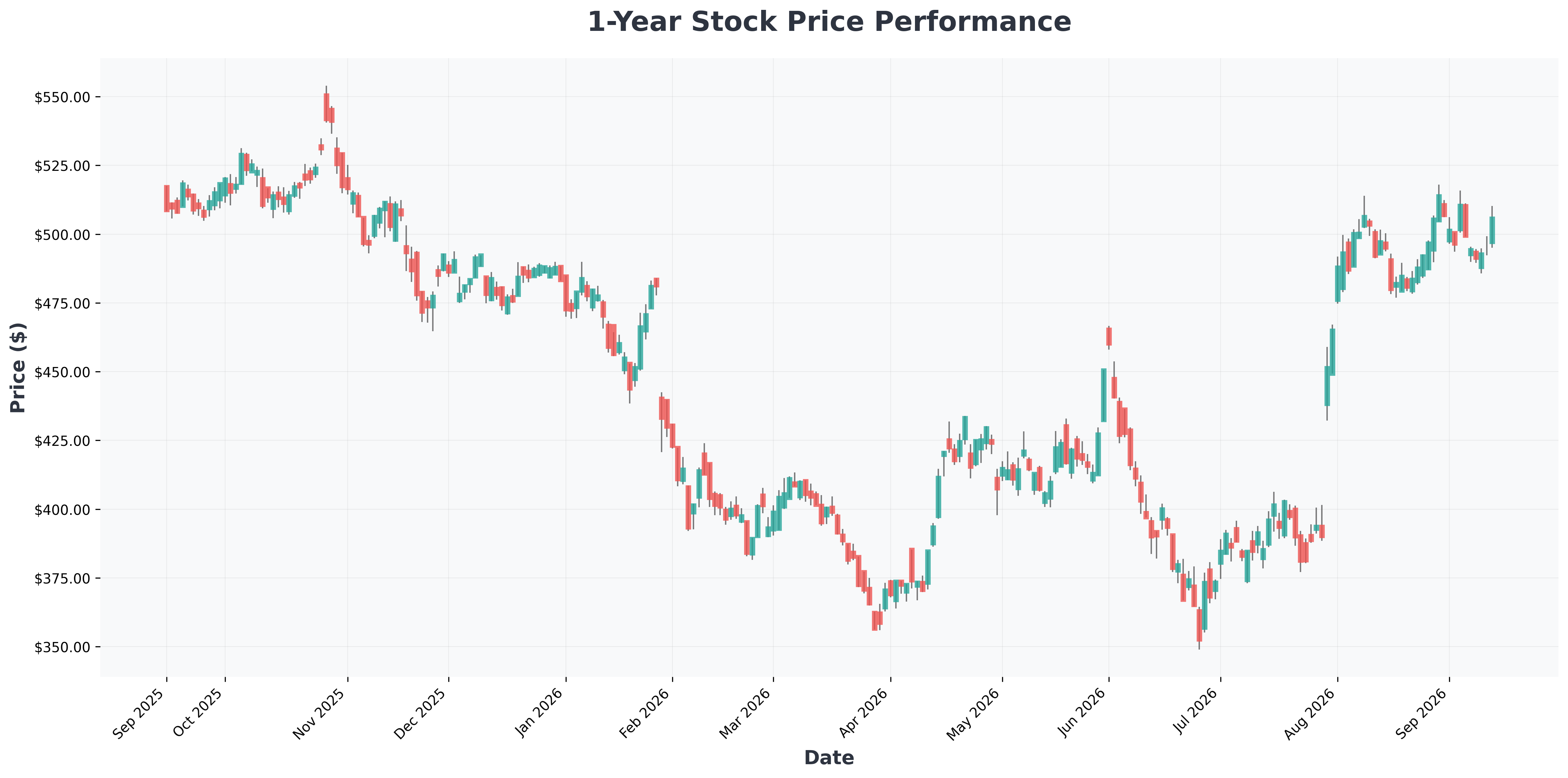
From a technical standpoint, VOOG has consistently respected its 200-day moving average during pullbacks over the past three years, with the $78–$80 zone acting as a structural support band. Historically, similar momentum-driven growth ETFs have seen drawdowns of 20–30% during rate-shock cycles, so position sizing matters even for long-term holders.
Scenario Analysis
Bull Case 🐂: AI capex continues through 2027, autonomous vehicles and humanoid robots enter commercialization, and VOOG compounds in the low-to-mid teens for another decade.
Bear Case 🐻: AI monetization disappoints, regulatory pressure hits mega-cap tech, and a 25–35% drawdown forces impatient investors to sell at the worst moment.
The bear case is survivable only if you genuinely never sell.
📊 In-Depth Fundamental Analysis
| Company | Share Price | P/E Ratio | P/B Ratio | ROE | Operating Margin (OPM) | Revenue Growth |
|---|---|---|---|---|---|---|
| AAPL (Apple) | $331 | 37.95 | 45.02 | 148.75% | 32.62% | 16.40% |
| AMZN (Amazon.com,) | $248 | 20.00 | 4.86 | 30.56% | 13.69% | 19.60% |
| AVGO (Broadcom) | $339 | 43.33 | 16.25 | 44.25% | 54.31% | 85.50% |
| GOOG (Alphabet) | $341 | 17.15 | 6.71 | 48.68% | 34.03% | 24.20% |
| GOOGL (Alphabet) | $345 | 17.32 | 6.78 | 48.68% | 34.03% | 24.20% |
| META (Meta) | $670 | 25.23 | 6.54 | 29.85% | 34.83% | 28.00% |
| MSFT (Microsoft) | $497 | 27.71 | 8.35 | 34.04% | 45.11% | 17.70% |
| NVDA (NVIDIA) | $212 | 26.82 | 22.37 | 117.21% | 66.24% | 105.90% |

The Verdict for a 20-Something Investor 🎯
VOOG isn't a trade — it's a 40-year commitment. The 0.07% expense ratio means Vanguard keeps almost nothing, and the fund's tilt toward momentum and sales growth gives it a structural edge over the plain S&P 500 in secular bull markets.
If you're in your 20s, the biggest risk isn't volatility — it's not owning enough growth while you have the time horizon to absorb it. A 25–30% drawdown at 28 is a footnote. The same drawdown at 58 is a crisis.
Past performance never guarantees future results, and concentrated tech exposure cuts both ways. But for investors who can truly hold forever, VOOG offers one of the cleanest ways to bet on the next 40 years of innovation.