The Hard Truth About Your Savings Account 💰
If you're a working-age adult thinking seriously about retirement, you've probably already figured out what most people eventually realize: building a meaningful nest egg is nearly impossible with a basic bank savings account.
Yes, you can shop around online banks and brokerages for money market yields hovering around 4%. But here's the problem — those rates don't consistently beat inflation. To actually get ahead, your money needs to grow significantly faster than the cost of living.
For most people, there's really only one proven path to that kind of growth: the stock market. 📈
That said, this isn't a call to dump every dollar into equities. Emergency funds and near-term expenses (like next semester's tuition) belong in safer, liquid accounts. But for long-horizon wealth building, savings accounts simply can't compete.

What the Stock Market Actually Is (And Why It Feels Chaotic)
It's tempting to view the market as a random casino of speculation. It isn't. Every share you own represents a tiny slice of ownership in a real company — Coca-Cola, Apple, Walmart, or Alphabet.
So why all the volatility? Because roughly 6,000 exchange-listed tickers are being bought and sold constantly, and investor opinions shift by the second. As legendary value investor Benjamin Graham put it:
"In the short run, the stock market is a voting machine. In the long run, it is a weighing machine."
Translation: fear and greed can push prices too far in either direction short-term, but over time, stock prices reflect real sales and profits. Patience wins. 🧘
The Simplest Answer: Index Funds
If picking individual stocks feels overwhelming, there's a clean solution: low-cost index funds like the SPDR S&P 500 ETF Trust (SPY) or the Vanguard S&P 500 ETF (VOO). These mirror the S&P 500 — 500 of the largest U.S. companies representing over 80% of total market value.
Historically, the S&P 500's long-term average annual return sits around 10% (with dividends reinvested). That's the compound engine that savings accounts can never match.
The debate over whether index funds or individual stocks deserve your capital is as old as the market itself. Here's how both sides see it:

The Math That Changes Everything 🔢
Here's what compound growth at a 10% average annual return actually looks like:
| Time Horizon | Value of $1 Invested |
|---|---|
| 10 years | $2.59 |
| 20 years | $6.73 |
| 30 years | $17.45 |
That last row is the one that matters. Thirty years turns $1 into $17.45 — a 1,645% gain that no savings account on Earth can replicate.
Ironically, the harder you try to beat the market, the worse you tend to do. Standard & Poor's data shows most actively managed U.S. mutual funds underperform their benchmarks. Even the pros rarely win. Your best statistical bet? Don't try to beat the S&P 500 — just own it.
One Foundational Stock Pick: Alphabet (GOOGL)
But let's say you still want a shot at outperforming. Consider something familiar: Alphabet (NASDAQ: GOOGL).
Yes, it's a volatile tech name waist-deep in AI uncertainty. But look closer:
- Over half of revenue still comes from Google search advertising
- Add YouTube, Android, Google Play, and subscriptions → ~80% of revenue
- Google handles ~90% of global web searches
- Android powers 69% of the world's mobile devices
The AI narrative dominates headlines, but Alphabet's core business is a near-monopoly on how the internet works. As long as the web exists, Alphabet is positioned to thrive. 📌
Technical Context
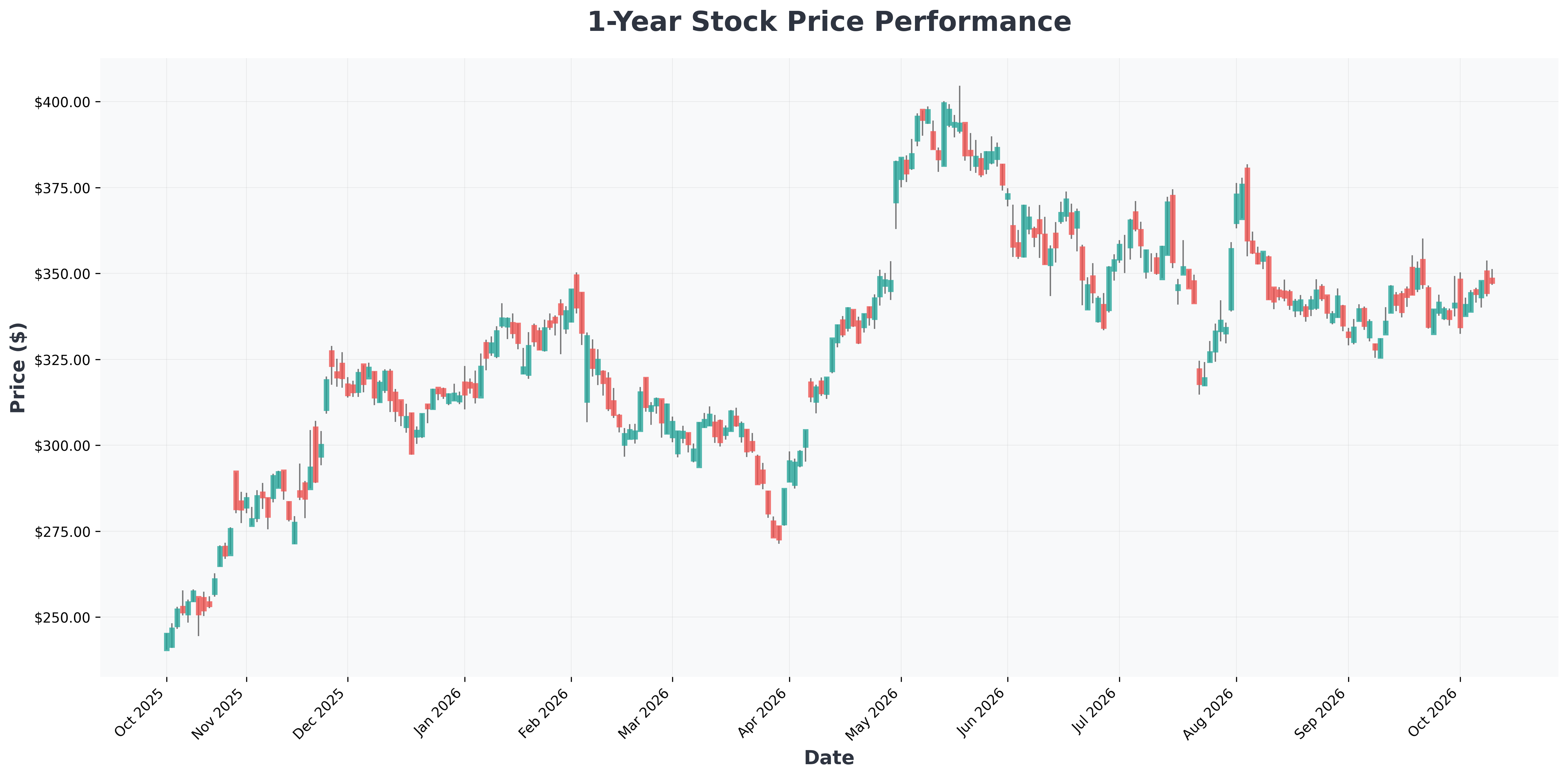
GOOGL's 52-week range ($239.71 – $408.61) shows just how wild sentiment has been. The $350 level has acted as a key pivot — holding above it keeps the bull structure intact, while a decisive break below could open the door to retesting the $300 psychological zone.
📊 In-Depth Fundamental Analysis
| Company | Share Price | P/E Ratio | P/B Ratio | ROE | Operating Margin (OPM) | Revenue Growth |
|---|---|---|---|---|---|---|
| GOOG (Alphabet) | $348 | 17.45 | 6.83 | 48.68% | 34.03% | 24.20% |
| GOOGL (Alphabet) | $352 | 17.64 | 6.91 | 48.68% | 34.03% | 24.20% |

The Bottom Line 🎯
Savings accounts have a role — but they're a parking lot, not a wealth engine. If your goal is to retire comfortably, the stock market remains the single best wealth-building tool available to ordinary investors.
Two Scenarios to Consider
🟢 Best Case:
- You dollar-cost average into VOO or SPY for 25–30 years
- Compound growth at ~10% turns modest contributions into a seven-figure nest egg
- A modest satellite position in GOOGL adds upside if AI monetization accelerates
🔴 Worst Case:
- You panic-sell during a 30% drawdown and lock in losses
- You chase meme stocks or hot AI names and underperform the index
- You leave cash in a 4% savings account and lose to inflation for a decade
Risk Warning
Equities are volatile. A 20–40% drawdown is normal and can happen at any time. Never invest money you'll need within 3–5 years, and always keep an emergency fund in cash. Past performance does not guarantee future results — but for long-horizon investors, time in the market beats timing the market. ⏳
