📉 The AI Storm is Shifting Gears
For much of 2024 and 2025, the market was obsessed with one narrative: AI will destroy the software industry. The logic seemed ironclad. AI agents would replace human workers, reducing the need for per-user SaaS licenses. AI coding tools like Claude Code would let companies build their own software, making legacy vendors like Salesforce obsolete.
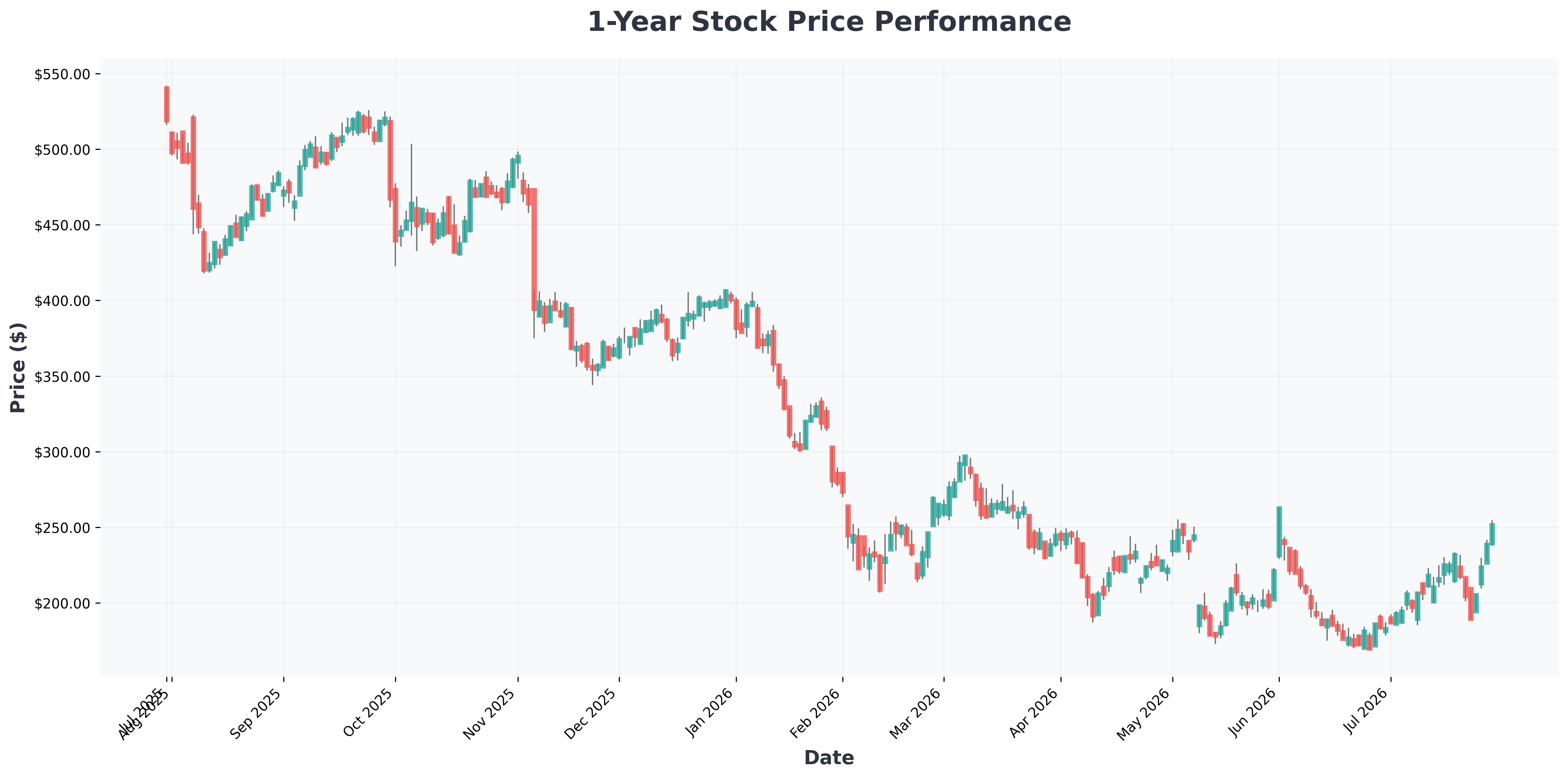
This fear sent the iShares Expanded Tech-Software ETF (IGV) down 11% year-to-date. But here's the twist Wall Street is just starting to digest: the AI trade itself is now unwinding.
Nvidia is down 16% from its high. AMD has plunged 21%. Micron has cratered 33%. The cost of deploying AI at scale is proving to be a massive hurdle. Uber blew through its entire 2026 AI budget in four months. Amazon and Walmart are capping AI usage. The very force that was supposed to crush software stocks is now losing momentum.
The question for investors: Is this the perfect time to buy the dip on IGV, or is this a value trap?
Let's break down the data.

🏢 Inside the IGV Portfolio: A Who's Who of Software Giants
IGV holds 107 stocks, but the top 10 positions account for over 50% of the fund. These aren't speculative startups; they are the backbone of the global enterprise.
The Heavy Hitters
| Ticker | Company | IGV Weight | YTD Performance (Approx.) |
|---|---|---|---|
| PANW | Palo Alto Networks | 9.62% | +50% 📈 |
| PLTR | Palantir Technologies | 8.66% | -26% 📉 |
| MSFT | Microsoft | 8.39% | -5% 📉 |
| CRWD | CrowdStrike | 6.85% | +50% 📈 |
| CRM | Salesforce | 5.31% | -27% 📉 |
| ORCL | Oracle | 5.11% | -8% 📉 |
| NOW | ServiceNow | 4.10% | -15% 📉 |
| APP | Applovin | 3.80% | +80% 📈 |
| ADBE | Adobe | 3.62% | -10% 📉 |
| FTNT | Fortinet | 3.58% | +35% 📈 |
📌 Key Insight: Notice the divergence. Cybersecurity stocks (PANW, CRWD, FTNT) are soaring because AI creates new attack surfaces. But the 'pure' SaaS plays (CRM, NOW) are getting hammered. This bifurcation is the key to understanding the ETF's potential.
The market is deeply divided on this ETF. Let's hear from both sides of the trade.

📊 The Case for a Rebound: Scenario Analysis
Here is where the contrarian thesis gets interesting. If the AI trade continues to deflate, the pressure on SaaS companies will ease. Companies that stopped buying new software licenses might come back to the table.
Best Case Scenario (Bullish) 🐂
- AI Hype Fades: The cost of AI becomes a barrier, not a tailwind. Companies realize building custom software with AI is still expensive and buggy.
- SaaS Re-Evaluation: Investors pivot back to predictable recurring revenue models. Salesforce, Intuit, and ServiceNow are valued for their cash flows, not their AI story.
- Result: IGV could rally 20-30% as the fear premium evaporates. Palantir, despite its high valuation, could stabilize as its government contracts provide a floor.
Worst Case Scenario (Bearish) 🐻
- AI is Real, Just Delayed: The current pullback is temporary. AI costs drop faster than expected, and the 'SaaS disruption' narrative returns with a vengeance in 2027.
- Valuation Compression: Stocks like Salesforce and Adobe trade at lower multiples as the market prices in a permanent growth slowdown.
- Result: IGV could drift another 10-15% lower. Palantir could be the biggest risk, given its sky-high P/E ratio.
📌 AI-Powered Insight: Historically, when the 'disruptor' (AI) hits its own cost crisis, the 'disrupted' (SaaS) often sees a relief rally. The pattern is similar to the 2000 dot-com crash, where infrastructure plays collapsed first, allowing profitable software companies to recover faster.
📊 In-Depth Fundamental Analysis
| Company | Share Price | P/E Ratio | P/B Ratio | ROE | Operating Margin (OPM) | Revenue Growth |
|---|---|---|---|---|---|---|
| NVDA (NVIDIA) | $195 | 29.82 | 24.17 | 114.29% | 65.60% | 85.20% |
| AMD (Advanced) | $485 | 161.26 | 12.27 | 8.06% | 14.40% | 37.80% |
| PLTR (Palantir) | $122 | 137.37 | 34.68 | 32.59% | 46.18% | 84.70% |
| CRM (Salesforce,) | $181 | 20.94 | 4.32 | 16.91% | 21.80% | 13.30% |
| CRWD (CrowdStrike) | $185 | 0.00 | 40.70 | -0.25% | -2.21% | 25.60% |
| WDAY (Workday,) | $158 | 49.26 | 5.89 | 10.86% | 13.30% | 13.50% |
| PANW (Palo) | $326 | 280.76 | 9.57 | 4.83% | -2.46% | 31.10% |
| TEAM (Atlassian) | $98 | 0.00 | 28.56 | -19.29% | 9.38% | 31.70% |
| INTU (Intuit) | $316 | 19.25 | 4.19 | 22.50% | 46.97% | 10.40% |
| MU (Micron) | $875 | 19.76 | 9.80 | 66.64% | 80.37% | 345.70% |
| MSFT (Microsoft) | $451 | 25.12 | 8.09 | 34.01% | 46.33% | 18.30% |
| HUBS (HubSpot,) | $233 | 122.04 | 6.06 | 5.01% | 3.30% | 23.40% |

🎯 Conclusion: A High-Risk, High-Reward Contrarian Play
The iShares Expanded Tech-Software ETF (IGV) is not a safe haven. It's a high-conviction bet that the market's primary fear (AI killing SaaS) is overblown and that the secondary fear (AI spending is unsustainable) will win out.
The Bull Case is compelling: You are buying a basket of the world's most dominant software franchises at a discount, with a tailwind from a potential AI spending slowdown.
The Bear Case is real: If AI costs collapse, the disruption thesis returns.
For investors: This is a tactical trade, not a set-it-and-forget-it buy. Watch the AI hardware names (NVDA, AMD). If they stabilize, the IGV thesis weakens. If they fall further, IGV could be a brilliant buy.
🚨 This is not financial advice. The software sector is volatile, and the AI landscape is evolving rapidly. Consider your own risk tolerance before investing.
